Sunday, December 2, 2012

Science: a family business?

1. As I was reading S Chandrasekhar's collection of essays and family reminiscences*, I couldn't help but notice the intellectual heavyweights in his family. Many of us know that his uncle, Sir C V Raman, was another eminent physicist and Nobel laureate. But how many of us know that his mother translated Henrik Ibsen's plays to Tamil, his sister Vidya Shankar was a notable veena artist, and his brother Purasu Balakrishnan, a notable physician, writer and Sanskrit scholar?

2. Likewise, on a previous trip to Madras, I met someone who was related to the Alladi Ramakrishnan family, and he informed me later on that V S Ramachandran, the eminent neurologist, is from the same lineage.

3. Yet again, as I was reading about microsaccades, a type eye movement that remains poorly understood even today, I was amused to learn that Robert Darwin, the father of Charles Darwin, was the first to describe them. Likewise, the wealthy Francis Galton, a cousin of Charles Darwin, although remembered more for promoting eugenics, described synesthesia, and promoted and financed the Biometrika journal, a watershed in 20th century statistical thinking.

These examples led me to ponder the idea popularized by Malcolm Gladwell, that one's environment is a much stronger determinant of success (however you choose to define it) than any individual traits. Incidentally, as I was researching the Alladi family, I encountered a note about a neighborhood called Palathope in Mylapore, Chennai, which produced an extraordinary number of lawyers during pre-independence India. This neighborhood reminded me of the Italian village Roseto Valfortore, which produced extraordinarily healthy immigrants.

While the idea of environment breeding success is by no means new, the above examples provoked a journalistic curiosity in me, to learn more about the inner workings of elite intellectual families throughout history.

Among other notable examples of intellectual families, I can recall Mary and Pierre Curie, Niels and Aage Bohr, and although not a family, Ernst Rutherford and his academic descendants. Anybody has any lesser known examples?

--------------------------xxxxxxxx--------------------------

*As I might never get around to writing a gushing review, I would like to note that Man of Science was a moving book, which gracefully captures the exalted thoughts of the great, and somewhat under-celebrated man that was Prof. Chandrasekhar. I would go so far as to confess that, reading the lectures of Chandra, his thoughts on great scientists and artists in history, his ideas about classical literature, private letters to his siblings, and the reminiscences of his family members, I felt the same emotions that Stephen Fry might have felt when he discovered Oscar Wilde, a private, incommunicable joy of having encountered a rare and kindred spirit from a bygone era.

Let me give you just one of at least a dozen examples from the book that helped me make the connection to Fry and Wilde. S Balakrishnan writes in a reminiscence after Chanrasekhar's death, about an incident shortly after Chandrasekhar returned from Cambridge with his PhD, and shortly prior to his departure for Chicago:

I recall on two evenings, we walked on the Marina of Madras. He was a recognized scientist. He had shot into the Indian sky like a meteor, or shall I say like Professor Heisenberg in the German sky. But I saw walking beside me an earnest, eager student, thinking only in terms of the pursuit of knowledge, warmed immediately by the mention of high endeavour in any sphere, persuading me, without being patronizing, to think highly of myself. Truly, here is the seed of greatness, I thought.

I was compelled to buy all of merely three copies from bookshelves in all of Chennai's bookstores, and distribute it to friends. One day in the near future, I hope to make the trip down to University of Chicago, where he did his life's work, and get access to his other books, Truth and Beauty, and Newton's Principia for the common reader.

[Link] A brief history of neuroscience

Resonance is a monthly magazine published by the Indian Academy of Sciences, targeted at high-school or undergraduate readers. I used to read it during my JEE days. I came across a very readable piece on the history of neuroscience.

Sunday, March 4, 2012

Newell's twenty questions

In an earlier post, I had brought up the contrasting attitudes towards what constitutes physics, attributed to Rutherford and Feynman, respectively.
That which is not physics is stamp collecting. ~Ernest Rutherford.
In the haughty perspective of Rutherford, the primary concern of science was to construct explanations (theories) for observed phenomena (stamps), and it was only the physicist who would fit this role. Indeed, under this view, it would seem that all other sciences were sources of observations for physics to explain.
Physicists often have the habit of taking the simplest explanation of any phenomenon and calling it physics, leaving the more complicated examples to other fields. ~Richard Feynman.
In the more humble of perspective of Feynman, it seems that the fields outside of physics patiently investigate and characterize anomalies lying outside the realm of the most common instance of a given phenomenon. Their role could thus be viewed as fulfilling the business of collecting and describing rare stamps. Rare stamps when fed back into the activity of theory building (Rutherford's physics), would enable the development of simpler theories with greater predictive power.

The blind men and the elephant

Image courtesy

To understand the state of a field in progress, it is worth considering the Indian parable of the blind men and the elephant. The story goes that six blind men decide to understand how an elephant looks by touching it. Each manages to touch only a small part of the elephant. As a result each develops strong beliefs about the nature of the elephant. They liken the tusk to a spear, the trunk to a snake, the tail to a rope, the feet to a tree, the ears to a fan, and the torso to a wall. Since they are unable to perform further experiments, they end up debating the nature of the elephant ad nauseum.

The gist of the parable is that (1) partial and noisy observations of a system result in erroneous conflicting hypotheses, and (2) the hypotheses are at a stalemate because of the lack of right tools to perform further experiments.

Enter Newell

With this background, it is perhaps useful to pause and consider what Alan Newell had to say back in 1973. Newell is known, among many things, for advocating the mind as an information processing system, along with his advisor and Nobel laureate Herbert Simon. In a valedicatory talk titled, You cannot play 20 questions with nature and win, he attempted to characterize the field of experimental psychology, and as we shall see, his ideas are broadly applicable to the state of cognitive neuroscience today. It is interesting to note that at the time of this lecture, Ed Posner, the founder of the Neural Information Processing Systems (NIPS) conference was in the audience.

To understand the essence of his ideas, let us consider the metaphor of nature as a jigsaw puzzle.

Imagine that you have the pieces of a jigsaw puzzle face down. You don't know what the puzzle looks like, and you don't know how many pieces there are. To flip each piece, you need to do very rigorous experiments and verify the results carefully, multiple times. Each piece may be likened to a phenomenon of the mind, such as auditory short term memory, or one of its properties, such as how long a certain type of information resides in auditory short term memory. The act of spotting each new piece may be likened to an observation of the phenomenon, and the act of flipping it may be likened to the careful elucidation of its properties. Each of these acts is performed by a number of scientists working together or independently, over a number of years. Sometimes new phenomena are discovered; at other times, new properties are elucidated. At still other times, a deeper understanding of the phenomenon is gained, as Feynman explains here with a chess analogy.

Newell articulated beautifully that the journey from empirical exploration to unified theory is a complex one. Consider the following paragraph:

I stand by my assertion that the two constructs that drive our current experimental style are (1) at a low level, the discovery and empirical exploration of phenomena [...] and (2) at the middle level, the formulation of questions to be put to nature that center on the resolution of binary oppositions. At a high level of grand theory, we may be driven by quite general concerns: to explore development; to discover how language is used; to show that man (sic!) is a processor of information; to show that he (sic!) is solely analysable in terms of contingencies of reinforcement responded to. But it is through the mediation of these lower two levels that we generate our actual experiments and give our actual explanations. Indeed, psychology with its penchant for being explicit about its methodology has created special terms, such as "orienting attitudes" and "pretheoretical dispositions," to convey the large distance that separates the highest levels of theory from the immediate decisions of day to day science.

Newell's attitude was as follows. One half of him was very excited about the fact that multiple new pieces are being discovered all the time. But another half of him was concerned that if the trend of upturning new jigsaw pieces was to be extrapolated into the future, the field would be nowhere closer to seeing how the pieces fit.

Consider this statement:

Science advances by playing twenty questions with nature. The proper tactic [hyperlink, mine*] is to frame a general question, hopefully binary, that can be attacked experimentally. Having settled that bits-worth, one can proceed to the next. The policy appears optimal--one never risks much, there is feedback from nature at every step, and progress is inevitable. Unfortunately, the questions never seem to be answered, the strategy does not seem to work.
*This is a reference to another outstanding opinion piece from the 1960s called Strong Inference by John Platt. He stresses the importance of alternate hypotheses and systematically ruling out one of the two, with examples from theoretical physics and molecular biology.

After commending a selection of outstanding individual studies for example, he states:

What I wanted was for these excellent pieces of the experimental mosaic to add up to the psychology that we all wished to foresee. They didn't, not because of a lack of excellence locally, but because most of them seemed part of a mosaic of psychological activity that didn't seem able to cumulate.

If you replace experimental psychology with cognitive neuroscience, and 1973 with 2012, Newell's assessment would still ring true.

In a subsequent post, I will get around to analyzing Newell's recommendations to get unstuck, and how they could apply to the state of modern cognitive neuroscience.

Monday, December 26, 2011

Science of the human condition

As 2011 draws to a close, here are two extremely broad BBC documentaries (and companion books) about what makes us fundamentally human.

The stunning Dr. Alice Robert's The Incredible Human Journey takes us through the migration of Homo Sapiens Sapiens from West Africa to every continent in the world between 70,000-10,000 years ago. It is a 5 part series (5 hours of screen time), with each episode focusing on one continent. A very broad and fascinating discussion including speciation, the hominini, various archeological sites, genetic evidence, climate models for sea levels, competing theories of our lineage, creation myths of indigenous peoples, and much more. Some thoroughly fascinating questions include: How many waves of migration from Africa eventually survived? One or several? Did we interbreed with the Neanderthals? Did East Asians evolve from the Homo Erectus? Guaranteed to stimulate. I'm currently reading Bryan Sykes's The Seven Daughters of Eve to get a richer understanding of the archeological and genetic methods involved in this richly interdisciplinary, politically charged, and data-starved field that attempts to provide a scientific alternative to epics and creation myths. Eager watchers, catch it on youtube before it gets taken down.


Stephen Fry's Planet Word takes us through the evolution, modern day use, and dysfunction of language and symbolic communication. The breadth of this 5 part series (yet again) is impeccable with a coverage of everything from Chimpanzee communication, the FOXP2 gene, Tourette's and swearing, an introduction to Ulysses, the creation of modern Chinese and much else. Unfortunately taken down from youtube.

"Exact science is not an exact science" ~Nicola Tesla according to Christopher Nolan, in The Prestige.

Here's to another year of awe and wonder!

Saturday, October 29, 2011

Change of seasons

The late October Sun smiled weakly today, like a devout caregiver who has been strong for too long, and is unable to hide his waning strength any longer. "Stay strong without me", he said, in an unsuccessful attempt to inspire fortitude during his absence. A yellow, perforated, autumn leaf fell to the matted brown floor lined with its recently deceased kin --- apologetic, for having overstayed its welcome, and in quiet acceptance of its fate. A solitary gull, now devoid of its cacophonous bravado that the summer warmth had inspired merely months ago, circled the Lehtisaari bridge in silent anticipation of the inevitable.

In Helsinki, the change of seasons is an everyday affair. Starting tomorrow, it's time to switch back the clocks and prepare for yet another winter.

Tuesday, September 6, 2011

How can the history of gravitational theory inform modern day neuroscience?

We've all heard it said before. Neuroscience is the physics of the 21st century. The vast ocean of unknowns lies before us, we've just learned to build a vessel, we've just learned to navigate. Let's unfurl the sails, go forth and discover new lands!
In this essay, I'll attempt to simplify such portentous omens by first prying open physics and then neuroscience.


The 20th century atomic physicist, Ernest Rutherford is famous for having said, "That which is not physics is stamp collecting". Let's indulge Rutherford for now, as we try to understand what he meant by physics. But first, let's start with a brief history of studying planetary motion.

Stamp collecting

Tycho Brahe, the Danish astronomer is most famous in the popular imagination for having observed the first modern supernova. However, a lesser appreciated fact about Brahe is that he extensively and systematically documented the trajectories of planets (#1).


In just a generation, along came Brahe's assistant, Johannes Kepler. Kepler deduced from all of Brahe's accurate observations that the trajectory of planets could be explained by three simple laws or regularities. First, by carefully making calculations of the Martian orbit, he noticed that all (known) planetary orbits were in fact elliptical, as opposed to the conventional Copernican belief before him that they were circular. He further noticed that the Sun was centered at one of the foci of the ellipses. Second, he noticed that the line joining the planet and the sun swept out sectors of equal areas along the orbit. Since orbits were elliptical, this implied that planets moved with variable speed---again a radical departure from Copernicus! He published both these observations in 1609 [I'm suprised he didn't write two papers on these potent mythbusters]. Third, he noticed that the square of the orbital period was proportional to the cube of the major axis of the elliptical orbit. He only published these 10 years later in 1619 [I wonder how he got tenure]. These are now known as Kepler's laws of planetary motion (#2).

Would Rutherford call Kepler a physicist? Would you call Kepler a physicist?

If we define a physicist narrowly as someone who engages in deductive reasoning based on observations of the natural world, then Kepler was not a physicist. However, if we recognize that a physicist must wear multiple hats along the journey from making observations (stamp collecting) to reasoning about them (physics a la Rutherford), then I would call him an exemplary physicist. Let's get more granluar about Kepler. What was he? Using modern terms, I would call him an applied statistician or more specifically, a curve fitter.

Kepler basically looked at the orbital trajectories and said, "wait a minute! this doesn't look circular to me. Hmmm...". He then selected a functional form to represent the trajectories (the equation of an ellipse) and simply fit the parameters to the data, the parameters being the foci and the major/minor axis of the ellipse to the orbit. Next, he looked carefully at the non-uniform speeds of the planet during the course of its revolution around the sun and said to himself, "Hmmm, what needs to be equal in order that the speeds can be unequal?". Finally he graphed the orbital period against the major axis length and mumbled, "There's a pattern here but I don't quite get it. Could it be a power law!". And it was.

In doing thus, Kelper had reduced the painstakingly detailed data recorded by Brahe into three simple regularities or laws. He made an epistemological innovation, i.e. he told us how to organize our observations neatly, in much the same way that Darwin organized species into the tree of life or Mendeleev organized the elements into a periodic table. Kepler's laws could now make accurate predictions about planetary motion.

In the parlance of modern statistics, we could interpret Kepler's laws as a descriptive statistical generative model. It described the statistics of planetary motion by generating them from underlying regularities. However, for all its genius, Kepler's work was merely descriptive, i.e. it succinctly answered the what questions but not the why questions. Why were planetary orbits elliptical? Why did they move faster when they came closer to the sun? For these answers, we had to wait another 100 years.

Newton and the why questions

Newton first formalized the concept of a force acting between two bodies. He postulated and verified the laws of motion. In posulating the gravitational force, and observing that the force was inversely proportional to squared distance, the universal theory of gravitation took shape.

Newton's theory was a causal explanation of the data observed by Brahe and the regularities captured by Kepler's laws: i.e. it could now answer the why questions. Just to take one example: as the planet comes closer to the sun, more force acts upon it, causing a greater acceleration increasing its speed!

I hazard a guess that Rutherford would have included Newton into his elite definition of a physicist!

Marr's three levels modified

From that prelude into the history of gravity, it is interesting to note that the answers to why questions also lead to how questions. How is gravitational force transmitted between two bodies without a medium? For nearly three centuries after Newton, a number of proposals were made for the mechanical explanation of gravity, all of which are known to be wrong today. The current explanation is attempted by quantum gravity, a theoretical framework that attempts to unify gravity with the other three fundamental forces, but as of today, we don't have a mechanistic explanation of gravity!

The sequence of what-why-how questions brings us to David Marr, a 20th century vision scientist and AI researcher, who postulated three necessary conditions for a computational theory of sensation or perception. Marr and his contemporaries conceived of vision as an information processing system. He said, to have a computational theory of a system, we need to understand:

  1. The computational level: what computation/ task does the system intend to perform?
  2. The algorithmic level: how does it represent this computation/ task and what strategies does it adopt to achieve its goal?
  3. The implementational level: what is the precise sequence of steps in the physical wet brain during the execution of the above algorithm?

Now, the universe is not an intentional system with a well defined goal, so Marr's postulates are more suited to building nature-inspired computational systems for solving specific tasks, rather than describing nature. Let's slightly modify (#3) Marr's levels to fit our what-why-how framework:

  1. What happens in the visual areas of the brain? [This is the stamp collecting task of Brahe]
  2. Can we build a simple statistical model that captures its regularities and predicts some of its dynamics? [This is the applied statistics / descriptive modeling task of Kepler]
  3. Why is it happening i.e. what is the brain trying to achieve through the observed dynamics? [This is the causal modeling task of Newton]
  4. How does it go about achieving its goal? [This is the mechanistic modeling task of quantum gravity]
Whither neuroscience?

With parables from Brahe down to Quantum Gravity, along with perspective from Marr, is it possible to meaningfully contextualize the need for theory in neuroscience as a discipline?

Let's take the primary visual cortex and see whether we can analyze developments about its understanding using the above framework.

The work of Brahe and (to a large extent) Kepler was done by the early greats (1960s onwards): David Hubel and Torston Wiesel. These guys measured from single neurons in the cat V1, recognized that there were cells selective to things like orientation, spatial frequency, ocular dominance, etc. [a Brahe task]. Next, along with Horace Barlow and other contemporaries, they explained natural images as constituted by oriented edges and gratings [a Kepler task]. Barlow and his contemporaries also attempted to give causal or normative explanations of what the visual cortex was doing. They proposed that the visual cortex was efficiently coding (in the Shannon information sense) the retinal image [a Newton task]. A little later, descriptive statistical generative models of natural images were proposed using Fourier and Gabor basis functions. The models were successful in describing the retinal image in terms of a few regularities [a Kepler task]. With the advent of artificial neural network models, it became possible to take the efficient coding hypothesis one step further and build mechanistic models of neural activity which efficiently represented the retinal image. It was possible to show mechanistically that efficient coding was realized by performing decorrelation in a distributed neural network to achieve this efficiency [a quantum gravity task]. With the advent of overcomplete basis functions: robustness, not just efficiency of visual information representation could also be normatively explained [a Newton task]. With further advances in natural image statistics by Olshausen and Field, it became clearer that besides efficient, decorrelated and robust coding of the retinal image, a key function of the visual cortex was to learn and update hypotheses (Bayesian posteriors) about the statistics of natural images [yet another Newton task]. How is Bayesian inference mechanically realized in a neural network? Again, artificial neural network models have been postulated for the same [yet another quantum gravity task].

One positive example does not make a theory, you quite rightly say (#4)? Ok. As we look around in other areas of neuroscience, what do we see?

I see that on a day to day basis we are all organized as cottage-industries and guilds, learning through apprenticeships, how to solve Brahe tasks, Kepler tasks, (and less frequently) Newton tasks, and quantum gravity tasks. Wider-scale databasing efforts [Brahe tasks] are also beginning to take place. Examples include Bert Sakmann's digital neuroanatomy project, the human connectome project (HCP), etc. Parallely, wider-scale big-data mining [Kepler tasks] is gaining ground. Examples include various connectomics projects, and contests to leverage big-data (such as the ADHD fMRI/ VBM/ DTI data analysis contest). Brahe and Kepler tasks certainly seem to be the mainstream activities of the day.

What do you see around you?

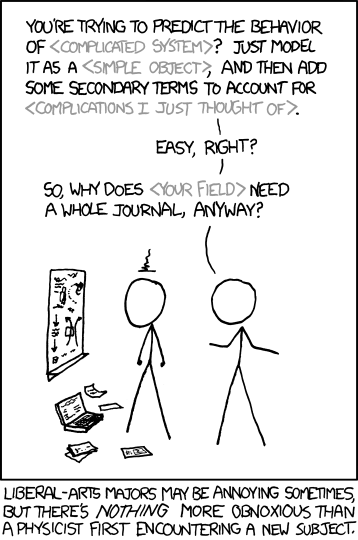
What would Feynman say to Rutherford?


The above comic strip generated some brilliant discussion in the forum. A commentor succinctly summarized this to be the everlasting tension between Rutherford's famous quote and a pithy equivalent by Feynman, attributing the following quote to the latter:

Physicists often have the habit of taking the simplest explanation of any phenomenon and calling it physics, leaving the more complicated examples to other fields.

Is neuroscience ready for Newtons, or do we still need more Brahes and Keplers for now?

Here's another gem from the forum:

Physicists who do bad biology say, "It's so simple! Look, model it so." These do not understand the concept of 'unknown unknowns.' What if, for example, your insects normally behave predictably, but release an alarm pheromone when handled clumsily - for example, by a theoretical physicist?

Physicists who do good biology say, "It's so messy! Is there any way we can control for as much of that messiness as possible? How do we pry apart this noise to get at the underlying rules?" They bring their disdain for vague claims to the field, and back up their claims with data. They aren't airy anti-biologists, but intense, experiment-driven pragmatists.

Notes

(#1) Incidentally, Brahe was not the first to catalogue planetary motion. The Babylonians, the Greeks and the Chinese each built their own MySQL servers to document the movement of heavenly bodies across the sky, with the Chinese effort taking up the most servers by far.

(#2) Interestingly, laws do not come to be known as laws as soon as they are proposed. Voltaire was the first to refer to Kepler's observations as laws in 1738, more than 100 years after they were first published!

(#3) Here's a very interesting modification of Marr's levels discussing the difficulty of studying of hierarchical with emergent properties.

(#4) In a Feynman sense, you just got physicisted!

Sunday, July 31, 2011

Microeconomic complexity and development

At TEDx Chennai 2010 I had the good fortune to meet Dr. Tara Thiagarajan, who heads Madura Microfinance. Tara blogs occasionally on issues peripheral to the business of microfinance. At Physics of Poverty, with her analytical background in neuroscience and complexity theory, she dissects questions about the meaning of socioeconomic development, and strives to bring those questions to the core rather than the periphery of the microfinance industry.

Her latest post, titled Productivity Line, attempts to reconceptualize the poverty line. She suggests that instead of dividing the world into segments based on their incomes, and then agreeing upon a reasonable income as the threshold, i.e. the poverty line, why not segment the world based on economic productivity?

Her post provoked a few questions about the relationship between production and consumption both at the social and the individual level. I note these below.

Firstly, I understand and acknowledge that taking a developmental design approach is more useful and socially sustainable than an approach that hand-holds the poorest of the poor just up to the threshold of the cycle of consumption.

1. What is an ideal ratio of producers to consumers in a society so that the society is economically sustainable (let's define economic sustainability as the capacity to diversify, grow and self-renew).

2. What is an ideal ratio of consumption to production in an individual's life? One could think of this ratio as an index of Marxist alienation and therefore a proxy to measure work-satisfaction or happiness.

3. In general, how do these ratios vary as a function of population size and other demographics as well as economic complexity (let's define economic complexity as the complexity of division of labor and the diversity of goods and services produced and consumed)? For instance, in a subsistence farming society where the economic complexity is relatively low, one could imagine that the ratio of producers to consumers is one, but that is scarcely an indicator of progress. Similarly in an extremely large and diversified society the ratio of consumption to production at an individual level is extremely high, but that is not an indicator of well being necessarily.

4. If one could measure these ratios from the demographic data of target communities receiving MFI, then one could go about defining bounds on these ratios and subsequently designing developmental interventions to optimize them.

Further Reading:
David Roodman's Open Book Microfinance Blog
The Institute for New Economic Thinking
A recent article comparing metrics of economic complexity using input-output measures
The building blocks of economic complexity: A white paper that applies complex network metrics to quantify macroeconomic complexity.